
Pediatric audiometry with the AT2000
Table of contents
- Episode 1
New user interface meets tried
and tested operation
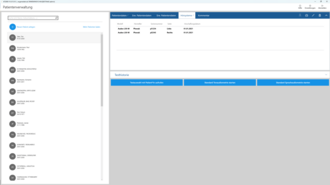
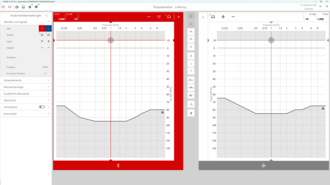
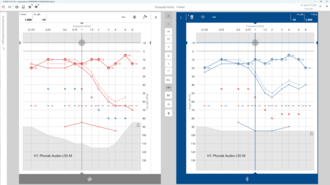
In this episode, I’ll be looking at the hardware and software and giving you an initial insight into the user interface and the data processing concept.
Firstly: we’ve retained tried-and-tested elements wherever possible and where it made sense to do so: the control panel remains identical to that of the latest version of the AT1000. The way you operate it remains the same – that was important to us!
It also made economic sense to retain the connections to the speakers and the furniture. Although we will need to run new cables when replacing the audiometers, this is considerably cheaper than replacing intact speakers. With the tables, too, one of the key principles of the redesign was that the existing furniture concept could be retained. However, should you have any specific requirements here, we would be happy to advise you, including with the help of the configurator.
We will carefully assess your individual situation regarding the test procedures and conditioning tools, such as the VRA Viewer. No completely new purchases will be necessary; for some licences, only upgrade costs will apply, which are lower than the cost of new licences. Your Lookyboxes can be connected without any technical issues.
The audiometer itself, however, is a completely new development: digital sound generation has replaced the analogue system, and the expected availability of the electronic components used was very important to us. We monitor this continuously with our German suppliers.
The software has also been rewritten. Our development team adhered to two principles in this regard:
1- To take into account your experience with the AT1000 and the features you consider useful,
2- To create a modern interface with a clear separation between test settings and the measurement interface: the audiograms take up a larger portion of the screen, and you are not distracted by an overloaded interface during the measurement.
You also requested that we expand the database, for example to provide more space for documenting hearing aids and to make the test history visible more quickly. We have implemented this and are now very keen to hear your feedback.
- Episode 2
Speech audiometry with children:
new testing methods and multilingualism
Today I’m writing about speech audiometry and how AURITEC has implemented it in the AT2000. Our customer groups are as diverse as their needs, so we’ve created a few options:
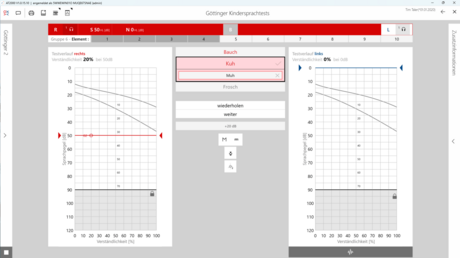
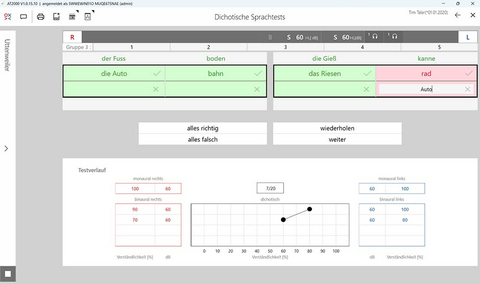
Firstly, there is the method of calculating the result of a speech audiometry test during the measurement. You can now choose whether you want the result displayed as the ratio of correct answers to the total number of words or numbers, or to the number of items presented. You can also note down the ‘incorrect’ answers and have them printed out. This is useful, for example, for speech therapy purposes.
If you see certain children frequently, it makes sense to shuffle the test lists to prevent a learning effect from occurring. With the AT2000, you can now randomize the order within a test list.
We have also been happy to fulfil another request: displaying the speech audiogram during measurement in speech audiometry without overlaying an audiogram. Overall, we want to give you the option to view additional information in speech audiometry too, without cluttering up the screen. Take a look and see if we’ve succeeded!
In addition, you can specify in the text field whether you are using monaural or binaural measurement conditions for a test.
We are rather proud to be able to offer you additional speech assessment procedures: together with partners, we have finalized and validated the Arabic OLKISA. This enables us to offer a comprehensive range of tests in Arabic for Arabic-speaking children across different age groups: the AAST, the OLKISA and the OLSA.
For young German-speaking patients, the new Mainz Children’s Test, MATCH, is exclusively integrated into the AT2000. Developed by the Department of Communication Disorders at Mainz University Medical Centre, the test features words commonly used today with a phoneme distribution reflective of current everyday language. Children aged 3 and above can complete the MATCH using a touchscreen. The test therefore does not necessarily assess the child’s speech ability. A female narrator’s voice and the test being designed as a game, which increases the child’s concentration span, are further advantages of the MATCH, which we regard as a welcome modernization compared to the old Mainz test.

- Episode 3
Integration of the WESTRA test
procedures and extended free-field measurement
In collaboration with WESTRA, we have succeeded in directly integrating the test procedures into the software. You can view all the procedures available to you right from the test selection screen and start them directly from there. The two main advantages are, firstly, that you no longer need to make any presets on the audiometer to ensure, for example, that the audiometer and test have the same volume. This means there is only one open window during the measurement, which makes conducting a test significantly more user-friendly. Secondly, by saving the measurement results for a selected patient directly to the database, you save valuable time, as all results appear in the test history.
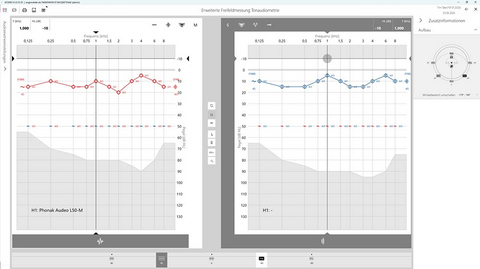
For the advanced free-field measurement, we have retained the basic concept of displaying all set-up speakers with their corresponding degrees below the audiogram. The currently active speaker is highlighted. Another new feature is that you can now also apply masking via a different transducer. This is highlighted both in the audiogram and in the polar plot on the right-hand sidebar, which can be expanded or collapsed. In response to popular demand, we have programmed the system so that the direction and type of signal are now also saved and documented in the measurement result. However, the “Advanced Free-Field Measurement” module still has two channels. If you wish to use speech in background noise plus a masking/drowning-out noise, use the “Multi-Channel Audiometry” module (see “Applications of the new AT2000 clinical audiometer”).
There is also a further innovation for all tone audiometric surfaces. The “steep narrowband noise” is available on the AT2000 as a new test signal, particularly for testing children. Due to its characteristics as a noise signal with a simultaneously high slope, it represents an interesting and frequency-specific test signal.
- Episode 4
Assessment of directional
hearing in children – ERKI
The ERKI system is now in use at many centers to test localization ability. This has resulted in a modern testing procedure for adults and children, designed to efficiently gather the most detailed information possible about the patient’s orientation abilities in a free-field environment. For hearing aid users in particular, this information can provide valuable insights into the current state of the fitting and any adjustments still required.
The ERKI system allows localization tests to be carried out on children from as young as 4 years old. To do this, signals from different directions are presented via the free-field loudspeakers. The use of a Mainz children’s table with at least three speakers is essential for this. By skillfully combining two speakers, sound can be coupled to create the auditory impression of a sound source located between them. This makes it possible to test a 180° range in small sections of up to 3°.
The patient enters their responses via a rotary knob and an LED light bar, which allows answers to be specified to the nearest degree. The playful approach to operation is particularly suitable for children and easy to implement. A privacy screen made of special acoustic fabric prevents the exact position of the speakers from being directly visible.
The ERKI can be used to derive approaches for the fine-tuning of hearing aids or to document the success of fittings. In cochlear implant (CI) users in particular, a distinct ‘plateau effect’ is evident in localization ability, meaning that from a certain angle of incidence and beyond, almost all signals are perceived very clearly as coming from the same direction. Here, the ERKI can clearly demonstrate the success of localization training.
Current research shows that an average ERKI score of 30% can be expected in CI patients. In particular, the results for children aged 8 and above are increasingly comparable to those of adults.

Jan Mody
Jan Mody is the managing partner of AURITEC. Together with his team, he has been working on the continuous further development of the Hamburg-based company's products since 2007. Maintaining the quality standards in clinical audiometry that have been in place for 30 years is always a priority for him.
Please feel free to contact us at any time:
vertrieb(at)auritec.de or 040 696540-0